counselor offers support when loved one dies
When a loved one or pet dies, we are often confronted with a range of emotions from grief, sadness and anger to guilt, denial and confusion.
"With some coping skills and support, dealing with it can be guided in an easier way," said Janice Barsky, who has a master's in counseling and owns the Guardian Angels LLC, which serves as court-appointed guardian for people who are unable to make their own decisions due to age or state of mind.
Barsky, 51, not only has received extensive training in grief counseling from Southwestern College in Santa Fe, she also has experienced it first-hand with the passing of her father as well seven of her own cats and dogs.
"When you lose a loved one, in essence, you are experiencing a traumatic event," she said. "Everything in a person's life changes in an instant.
This is frightening, and confusing. One of the most important ways to heal through a traumatic situation is to talk about it over and over and over again.
If you happen to be dealing with a person who has lost a pet, family member or friend, three important phrases you can say are "I am so sorry for your loss," "Tell me what happened," or "Tell me about your life together," Barsky said.
The reason this is important is because every time a person talks about the situation, it allows them to desensitize themselves from it. But it's difficult for many people to hear the painful stories again and again.
Barsky also recommends not using phrases such as "He lived a good life," "they're in a better place," or "only the good die young."
In addition, for people who are grieving, it is important to eat right, get plenty of sleep and take car of themselves. Friends and loved ones should be persistent about checking in and offering help.
One of Barsky's passions is using her skills with pet owners.
"When a pet dies, this is a member of their family, and they are devastated," she said. "However, in society, pet owners experience a sort of disenfranchised grief, because the grief is not accepted or understood.
"When your pet dies, you do not get a day off from work" Barsky said "Many people will suggest going out and buying a new pet. But for pet owners, this can be a very insensitive.
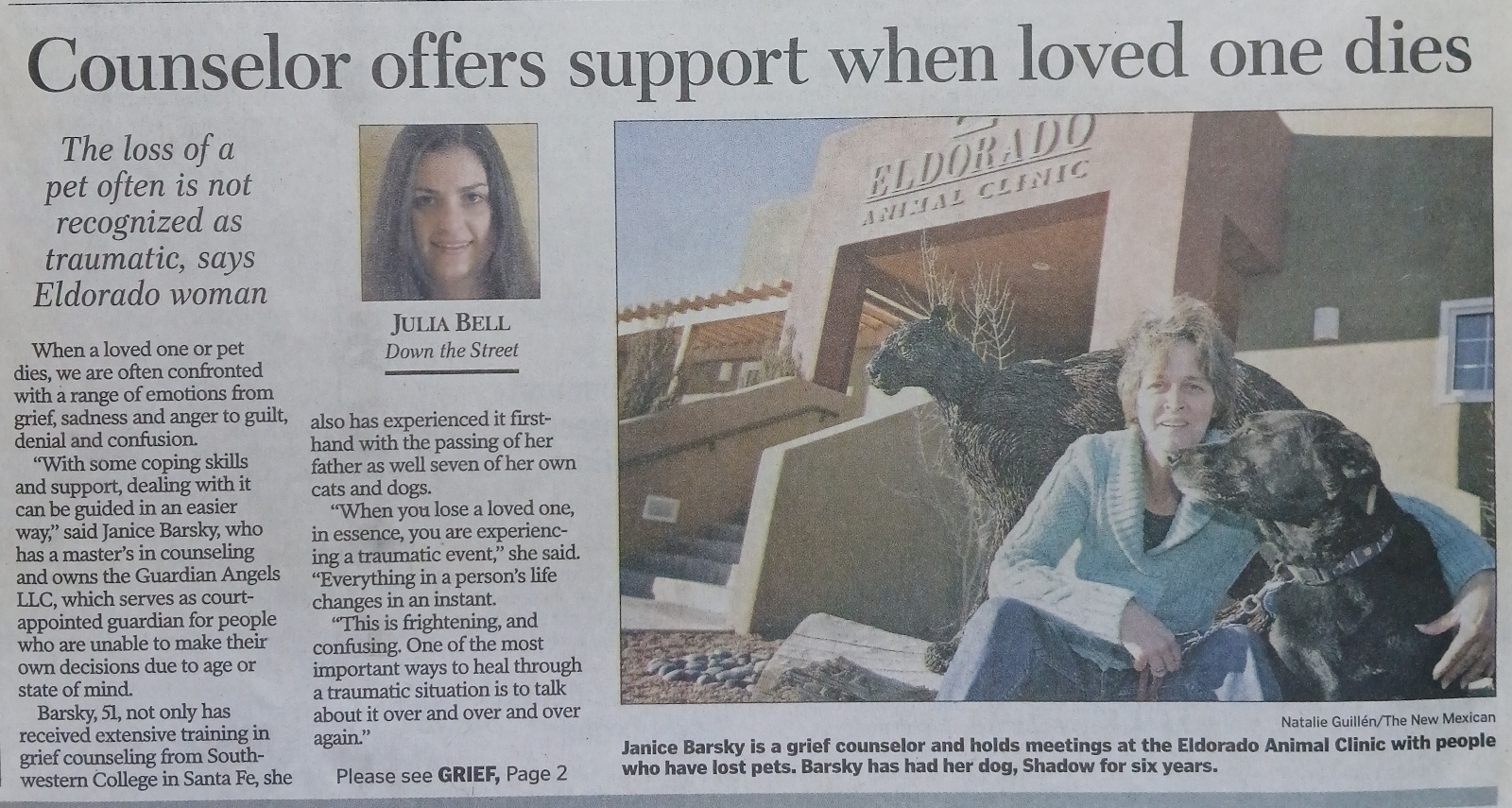
Because of that, she decided to start pet-loss support groups. Barsky begins a seKsion by asking participants to light candles in memory of their deceased pet. While everyone is invited to talk about their losses, no one is forced to speak. There are no demands for sharing information or feelings. The only rules are that advice should not be given to others and everything said during the session is viewed as confidential.
One of Barsky's goals during the sessioms is to help people understand that grieving is not a linear process. Emotions can and often do go up and down.
"You might not cry for a week, and then all of a sudden break down in tears," she said "This is normal."
"Some of the people that begin to make peace with death are the people that are able to transform their devastating grief into an opportunity to grow," Barsky said. "I have met women who never knew any of their finances while their husbands were alive. Upon their passing, these women had to dig down deep and find a strength that had always been inside of them. Some started their own businesses while others became the matriarchs of their family."
A pet owners support group will run from 6:15 to 7:45 pm tonight at the Eldorado Animal Clinic, 20 Chamisa Drive North sessiorus are continuous and can joined at any time. There is no fee, but donations are accepted Bring photos of your pet along with your fondest memories.
Grieving pet owners who want to receive one-on-one counseling can arrange for private sessions with Barsky. She offers a sliding scale and can be reached at 466-3500.
Published in the New Mexican, El Dorado Edition on 2006-01-25.