food is more than stuff to eat, says chef
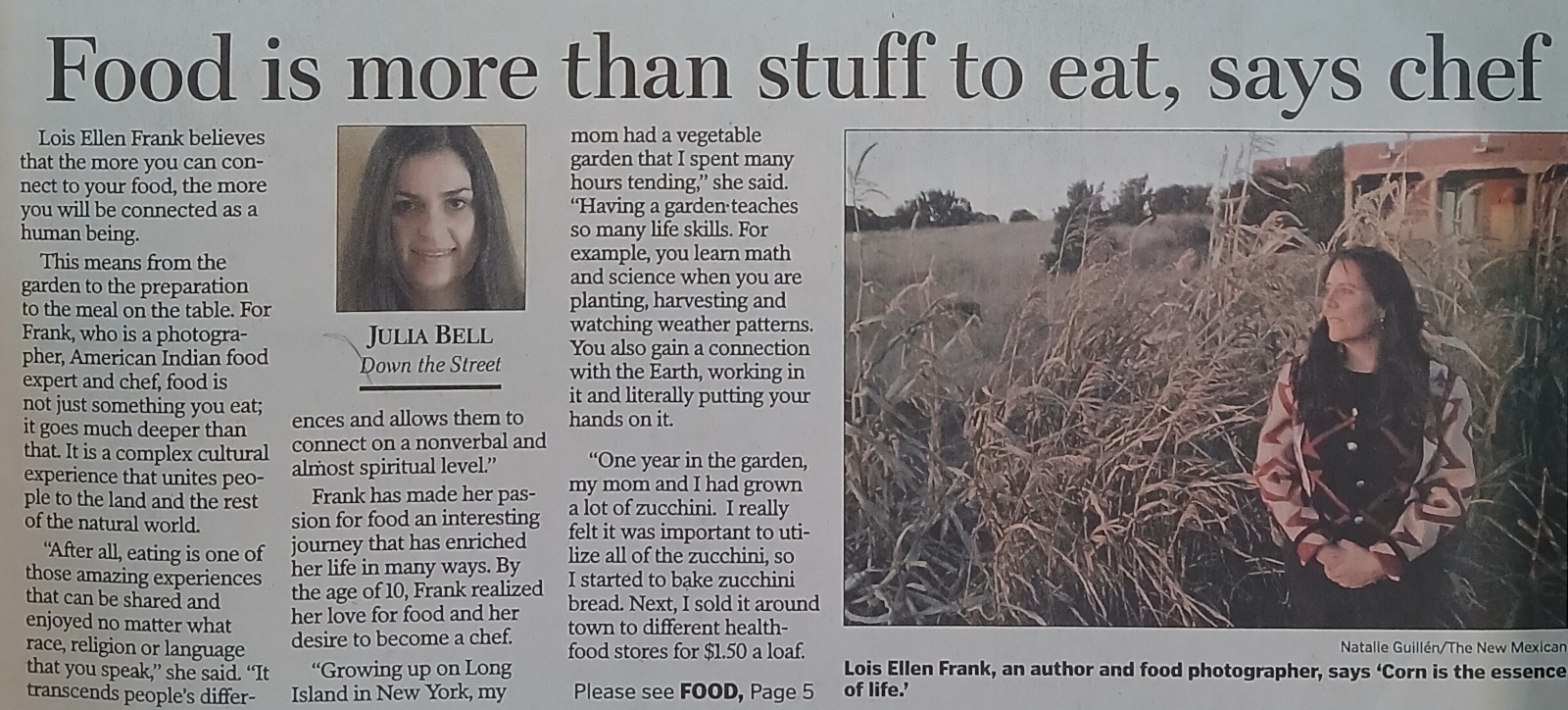
Lois Ellen Frank believes that the more you can con- nect to your food, the more you will be connected as a human being.
This means from the garden to the preparation to the meal on the table. For Frank, who is a photographer, American Indian food expert and chef, food is not just something you eat; it goes much deeper than that. It is a complex cultural experience that unites people to the land and the rest of the natural world.
"After all, eating is one of those amazing experiences that can be shared and enjoyed no matter what race, religion or language that you speak" she said. "It transcends people's differences and allows them to connect on a nonverbal and almost spiritual level."
Frank has made her passion for food an interesting journey that has enriched her life in many ways. By the age of 10, Frank realized her love for food and her desire to become a chef.
"Growing up on Long Island in New York, my mom had a vegetable garden that I spent many hours tending," she said. "Having a garden•teaches so many life skills. For example, you learn math and science when you are planting, harvesting and watching weather patterns. You also gain a connection it and literally putting your hands on it.
"One year in the garden, my mom and I had grown a lot of zucchini. I really felt it was important to utilize all of the zucchini, so I started to bake zucchini bread. Next, I sold it around town to different health-food stores for $1.50 a loaf.
I didn't make that much money; actually, I think I lost money, but I utilized all of the zucchini."
For Frank, connecting with the Earth and food has been a constant concept since childhood. Her maternal grandfather and mother were members of the Kiowa tribe and held the highest respect for the Earth as a source of food. Frank grew up to understand that the dinner table is a sacred and safe place that nourishes the body, mind and soul. Frank also gained an affinity for food from her paternal grandmother, who was of Sephardic Jewish heritage. She cooked many specialties, but Frank's favorite is matzo-ball soup.
When Frank was ready to attend college, she knew that she wanted to be a chef. Unfortunately, it was the late 1970s and gender barriers still existed in the field in New York City. So she attended the Brooks Institute of Photography in Santa Barbara, California to nurture her other passion, photography.
To pay for tuition, Frank got a job in a restaurant as a line cook. As part of her assign- ments, she focused some of her photography on the art of food.
"I would often photograph delicious items that I could justify buying, like lobster and crab," she said. "After I photographed them, I would create a delicious meal. It was the best of both worlds."
After a year, Frank received a prestigious scholarship as a food photographer.
In a speech she gave at commencement she said, "We as photographers can use our photographic images to move people, to make them think, to influence their decisions and to represent people and their ways of life."
Frank set out to make her mark by moving to Los Angeles and entering the advertising business. After many successful years, she realized she missed being with other chefs. She reconnected with one of her good friends, chef Mark Miller. Miller recommended they venture to Mexico to study chile and corn. They also traveled from the Peabody Museum in Boston to the wilds of the Andes and have gone back on exotic journeys to the grasslands of Mexico, where the first domesticated corn was grown. From these trips, Miller and Frank connected with people of different cultures, studying and tasting foods. They also developed the famous chile and corn posters that educated the public about the varieties and histories of chile and corn.
During this time, Frank realized her love for the research end of food, which brought her to academia. Miller went on to open some world-famous restaurants himself, such as Coyote Café in Santa Fe and the Red Sage in Washington, D.C.
After visiting Santa Fe, Frank fell in love with it and moved here in 1990. In 1996, Frank enrolled in The University of New Mexico's masters program in culinary anthropology, where she did her thesis on the importance of corn as a common thread among indigenous tribes in the Americas. She's now studing for a doctorate in the program nad hopes to achieve her degree by 2008.
Whehter we call it corn, Indian corn, maize or zea mays, it's all the same thing, Frank writes in her James Beard Award-winnig cookbook Foods of the Southwest-Indian Nations. Corn, originally an undomesticated wild grass, was turned into a food that would dominate ancient American agriculture for thousands of years and influence cuisines all over the world. Because of the beauty of corn's color and form, many indigenous people found time to develop around it a culture of art, science, literature, and religion. The significance of corn to rituals and creation narratives is part of the story of corn. Corn made cultural development possible by supporting dense concentrations of populations.
For Frank, corn is the mother.
"It represents the life cycle of the human beings from the planting of a seed to the growing process to death," she said. "The cornstalk dries in the field, leaving behind new kernels, new seeds for life for future generations to continue the cycle. Corn in the Southwest is the essence of life."
Frank lived her research by spending many years visiting and living on Southwest Indian reservations.
"I learned form the elders where to find, how to harvest, and how to prepare many different Native American foods from different nations," she said. "The elders taught me traditional methods of cooking as well as new approaches. I worked with several generations of women in a single household, as well as with contemporary Native chefs, both women and men who worked in restaurants."
Throughout the whole process, Frank photographed many of hte people and the food-preparation techniques. She also cooked for hundreds of people during feasts, festivities, and ceremonies.
"I have become like a daughter to some of the families and am expected to help with preparing food and serving the invited guests year after year," she said. "It has been a privelege and an honor to be invited into so many households."
She met chef Walter Whitewater, who would become her business partner. Whitewater was born in Pinon, Arizona and is Navajo. He grew up learning traditional customs and began cooking in 1992 in Santa Fe at Cafe Escalera. After cooking with some well-known chefs, Whitwater became the culinary advisor on Frank's cookbook.
After the release of her first book on Indian foods, Frank and several other young chefs — Walter Whitewater, Jeff Koscomb and Aland Humphries — toured the United States cooking many of these foods at restaurants.
"During our travels, the ingredients that were not available to us we harvested and brought ourselves," she said. "We travelled with freshley harvested prickly peras, acorn nuts and Indian tea to name a few and cooked them in some of the finest restaurants in the United States."
At the end of their journey, Frank and Whitewater decided to open their own business, Red Mesa, an American Indian catering and food company offering a unique Southwest American Indian cuisine experience using ancient ingredients with a modern twist. Red Mesa cooks for private events, parties, corporate meetings and Indian events and organizations all over the United States. In addition, they also create culinary catalogs showcasing unique kitchen accountrements.
The two have worked together with many different American Indian food and health programs. They opened the exhibit "Totems to Turquoise" at the Autry National Center and Southwest Museum in Los Angeles with a food tasting and lecture in April.
For Frank, food is the essence of life. What you put into it is what you get from it.
"I also believe in the nontangible essence of food," she said. "Whatever you are thinking or feeling while you are cooking or working with food is transferred into that food. So if you are feeling loving, people will be eating that love. However, if you are angry, people will be eating that anger. So it is really important to be conscious of how you are feeling in the kitchen."
For more information call 466-6306 or e-mail at nativecooking@yahoo.com.
Published in the New Mexican El Dorado Edition on 2006-10-25.