pumpkins
Autumn arrives and fireplaces crackle'. The soft scent of pinon tills the air. Children tand adults) dress up as ghosts and goblins to celebrate Halloween, or build altars to welcome departed family mem- bers on the Days of the Dead.
For many people, though, the most recognizable symbol of the fall season is a pumpkin — whether it's carved into a jack-o'-lantern or baked into a spicy pumpkin pie.
Pumpkins are more than decoration or dessert, though. The rotund fruit has been cultivated in Central America for at least 9,000 years, and pumpkin remains have been found in the ancient cliff dwellings in what is now the American Southwest
Pumpkin flesh, seeds and flowers star in both savory and sweet dishes. The French love their pumpkin soups, while Cypriots stuff pasties With pumpkin and crushed wheat. Aztec and Mayan cOoks used pumpkin seeds to enrich sauces — a practice that continues to this day in pipianes, stews originating in Central Mexico and the Yucatan. In Spain and Mexico, roasted or fried pumpkin seeds (pepitas) are a popular, year-round snack.
Today, we know that the pumpkin is more than just a pretty — or scary! — orange face. It is also a nutritional powerhouse.
Dr. Andrew Weil, director of the Program in Integrative Medicine and clinical professor of Internal Medicine at the University of Arizona in rmcson, says that "pumpkins are not only delightful to look at" He also stresses "the importance of the abundance of vitamin A and beta carotene in these members of the gourd family."
According to Weil, "(Pumpkins) — as well as all winter squashes— appear to reduce the risks of many cancers, including breast cancer."
Dr. Art Clene, clinical professor of obstetrics and gynecology at the University of Southern California's Keck School of Medicine and author of more than 50 health-related books, concurs. "Most people do not know that pumpkins may be a cancer-fighting food containing large amounts of beta carotene antioxidants that help neutralize cell- damaging free radicals, according to a recent study at lilfts Universi- ty," he says.
Two Santa Fe chefs — Augusto Delprado of Il Piatto and Ariel Harrison of the Chocolate Maven Bakery and café — also admit to having a soft spot for this curva- ceous fruit, and they are happy to share some of their most popular pumpkin recipes with us.
recipes
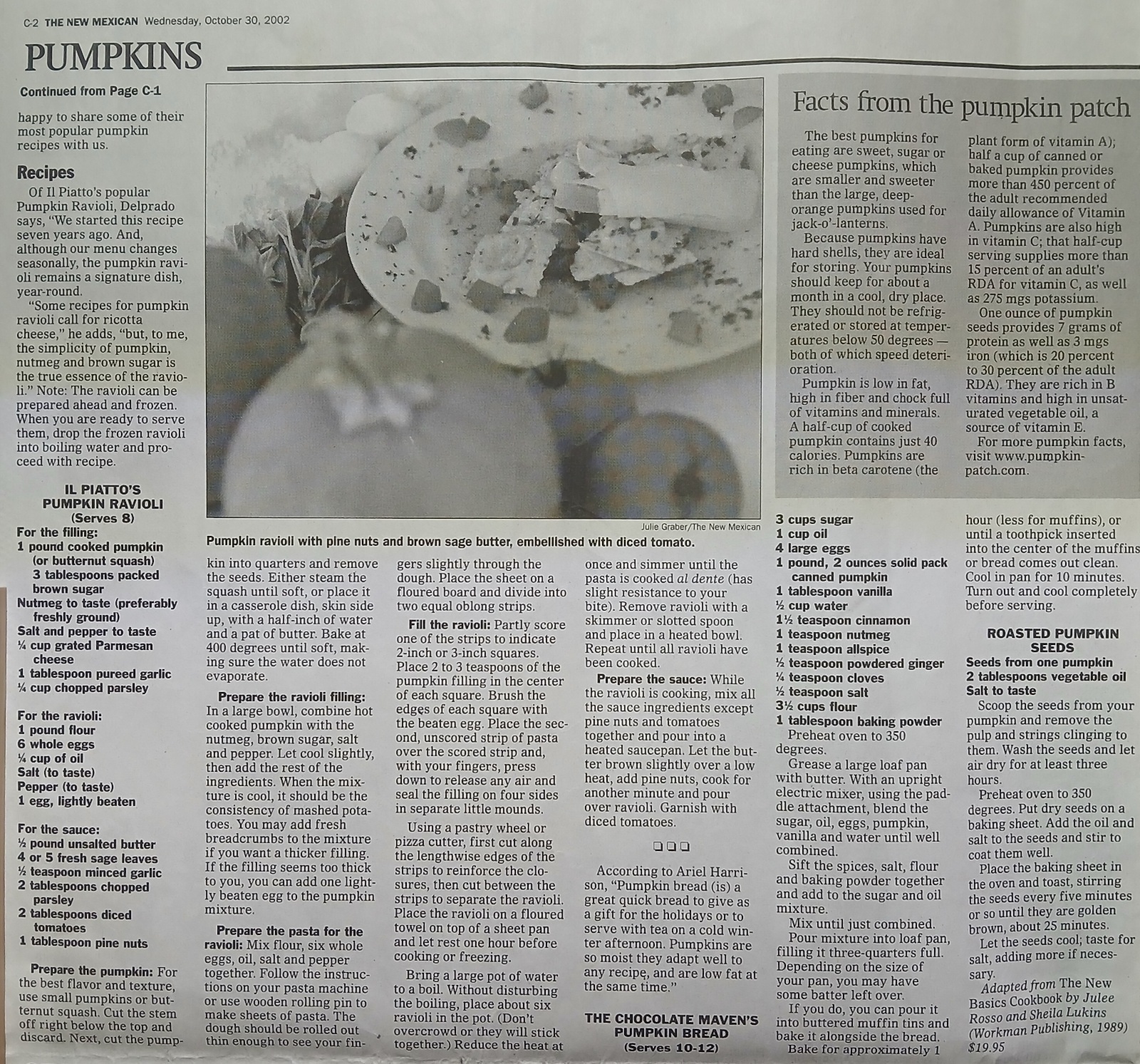
Of Il Piatto's popular Pumpkin Ravioli, Delprado says, "We started this recipe seven years ago. And, although our menu changes seasonally, the pumpkin ravi- oli remains a signature dish, year-round.
"Some recipes for pumpkin ravioli call for ricotta cheese," he adds, "but, to me, the simplicity of pumpkin, nutmeg and brown sugar is the true essence of the ravio- li." Note: The ravioli can be prepared ahead and frozen. When you are ready to serve them, drop the frozen ravioli into boiling water and pro- ceed with recipe.
IL PIATTO'S PUMPKIN RAVIOLI
(Serves 8)
For the filling:
- 1 pound cooked pumpkin (or butternut squash)
- 3 tablespoons packed brown sugar
- Nutmeg to taste (preferably freshly ground)
- Salt and pepper to taste
- 1/4 cup grated Parmesan cheese
- 1 tablespoon pureed garlic
- 1/4 cup chopped parsley
For the ravioli:
- 1 pound flour
- 6 whole eggs
- 1/4 cup of oil
- Salt (to taste)
- Pepper (to taste)
- 1 egg, lightly beaten
For the sauce:
- 1/2 pound unsalted butter
- 4 or 5 fresh sage leaves
- 1/2 teaspoon minced garlic
- 2 tablespoons chopped parsley
- 2 tablespoons diced tomatoes
- 1 tablespoon pine nuts
Prepare the pumpkin: For the best flavor and texture, use small pumpkins or butternut squash. Cut the stem off right below the top and discard. Next, cut the pumpkin into quarters and remove the seeds. Either steam the squash until soft, or place it in a casserole dish, skin side up, yith a half-inch of water and a pat of butter. Bake at 400 degrees until soft, mak- ing sure the water does not evaporate.
Prepare the ravioli filling: In a large bowl, combine hot cooked pumpkin with the nutmeg, brown sugar, salt and pepper. Let cool slightly, then add the rest of the ingredients. When the mix- ture is cool, it should be the consistency of mashed potatoes. You may add fresh breadcrumbs to the mixture if you want a thicker filling. If the filling seems too thick to you, you can add one lightly beaten egg to the pumpkin mixture.
Prepare the pasta for the ravioli: Mix flour, six whole eggs, oil, salt and pepper together. Follow the instructions on your pasta machine or use wooden rolling pin to make sheets of pasta. The dough should be rolled out thin enough to see your fingers slightly through the dough. Place the sheet on a floured board and divide into two equal oblong strips.
Fill the ravioli: Partly score one of the strips to indicate 2-inch or 3-inch squares. Place 2 to 3 teaspoons of the pumpkin filling in the center of each square. Brush the edges of each square with the beaten egg. Place the second, unscored strip of pasta over the scored strip and, with your fingers, press down to release any air and seal the filling on four sides in separate little mounds.
Using a pastry wheel or pizza cutter, first cut along the lengthwise edges of the strips to reinforce the closures, then cut between the strips to separate the ravioli. Place the ravioli on a floured towel on top of a sheet pan and let rest one hour before cooking or freezing.
Bring a large pot of water to a boil. Without disturbing the boiling, place about six ravioli in the pot. (Don't overcrowd or they will stick together.) Reduce the heat at once and simmer until the pasta is cooked al dente (has slight resistance to your bite). Remove ravioli with a skimmer or slotted spoon and place in a heated bowl. Repeat until all ravioli have been cooked.
Prepare the sauce: While the ravioli is cooking, mix all the sauce ingredients except pine nuts and tomatoes together and pour into a heated saucepan. Let the butter brown slightly over a low heat, add pine nuts, cook for another minute and pour over ravioli. Garnish with diced tomatoes.
According to Ariel Harrison, "Pumpkin bread (is) a great quick bread to give as a gift for the holidays or to serve with tea on a cold winter afternoon. Pumpkins are so moist they adapt well to any recipe, and are low fat at the same time."
THE CHOCOLATE MAVEN'S PUMPKIN BREAD
(Serves 10-12)
- 3 cups sugar
- 1 cup oil
- 4 large eggs
- 1 pound, 2 ounces solid packed canned pumpkin
- 1 tablespoon vanilla
- 1/2 cup water
- 1teaspoon cinnamon
- 1 teaspoon nutmeg
- 1 teaspoon allspice
- 1/2 teaspoon powdered ginger
- 1/4 teaspoon cloves
- 1/2 teaspoon salt
- 3 1/2 cups flour
- 1 tablespoon baking powder
Preheat oven to 350 degrees.
Grease a large loaf pan with butter. With an upright electric mixer, using the paddle attachment, blend the sugar, oil, eggs, pumpkin, vanilla and water until well combined.
Sift the spices, salt, flour and baking powder together and add to the sugar and oil mixture.
Mix until just combined.
Pour mixture into loaf pan, filling it three-quarters full. Depending on the size of your pan, you may have some batter left over. If you do, you can pour it into buttered muffin tins and bake it alongside the bread.
Bake for approximately 1 hour (less for muffins), or until a toothpick inserted into the center of the muffins or bread comes out clean.
Cool in pan for 10 minutes. Turn out and cool completely before serving.
ROASTED PUMPKIN SEEDS
- Seeds from one pumpkin
- 2 tablespoons vegetable oil
- Salt to taste
Scoop the seeds from your pumpkin and remove the pulp and strings clinging to them. Wash the seeds and let air dry for at least three hours.
Preheat oven to 350 degrees. Put dry seeds on a baking sheet. Add the oil and salt to the seeds and stir to coat them well.
Place the baking sheet in the oven and toast, stirring the seeds every five minutes or so until they are golden brown, about 25 minutes. Let the seeds cool; taste for salt, adding more if necessary
Adapted from The New Basics Cookbook by Julee Rosso and Sheila Lukins (Workman publishing, 1989) $19.95
facts from the pumpkin patch
The best pumpkins for eating are sweet, sugar or cheese pumpkins, which are smaller and sweeter than the large, deep-orange pumpkins used for jack-o'-lanterns. Because pumpkins have hard shells, they are ideal for storing. Your pumpkins should keep for about a month in a cool, dry place. They should not be refrigerated or stored at temperatures below 50 degrees — both of which speed deterioration. Pumpkin is low in fat, high in fiber and chock full of vitamins and minerals. A half-cup of cooked pumpkin contains just 40 calories. Pumpkins are rich in beta carotene (the plant form of vitamin A); half a cup of canned or baked pumpkin provides more than 450 percent of the adult recommended daily allowance of Vitamin A. Pumpkins are also high in vitamin C; that half-cup serving supplies more than 15 percent of an adult's RDA for vitamin C, as well as 275 mgs potassium. One ounce of pumpkin seeds provides 7 grams of protein as well as 3 mgs iron (which is 20 percent to 30 percent of the adult RDA). They are rich in B vitamins and high in unsaturated vegetable oil, a source of vitamin E. For more pumpkin facts, visit pumpkin-patch.com
Published in the New Mexican on 2002-10-30.